
photography-photo-critique-course
The Art ofPhoto Critique
Learn how to read, evaluate and improve photographs using a clear professional system—without needing to buy a new camera.
Better photographs begin with better observation.
This course teaches you to slow down, study an image and make informed decisions. You will learn what attracts attention, what weakens a photograph and what can be improved in-camera or during editing.
- Recognise visual impact and a clear subject
- Analyse composition, balance and eye movement
- Evaluate light, exposure, focus and colour
- Identify distracting backgrounds and weak storytelling
- Make stronger crop and editing decisions
- Select photographs for a portfolio or print
The ITIAN 10-Point Critique System
Score each category from 1–10. The score guides observation; the written reasons and improvement decisions create the learning.
Final decision: Keep • Improve • Reject
Course Lessons
Explore the course here, then open each substantial tutorial on its own focused page.
Welcome to Photo Critique
Meet the course, understand the learning pathway and complete your starting self-assessment.
Open Lesson 1 →Learning to See
Train your eye to recognise impact, distractions, balance, mood and the strongest part of a frame.
Open Lesson 2 →The 10-Point System
Learn how to score consistently and support every score with useful observations.
Open Lesson 3 →Reading a Photograph
Follow the viewer’s eye and identify subject, hierarchy, context, emotion and visual flow.
Open Lesson 4 →Composition Critique
Evaluate framing, balance, perspective, leading lines, negative space and horizon placement.
Open Lesson 5 →Lighting Critique
Assess direction, quality, contrast, shadows, highlights and whether the light supports the subject.
Open Lesson 6 →Technical Quality
Review exposure, focus, sharpness, depth of field, motion, noise and lens-related issues.
Open Lesson 7 →Colour and Tone
Evaluate white balance, harmony, saturation, tonal separation and black-and-white potential.
Open Lesson 8 →Storytelling Critique
Decide what the image communicates and whether its subject, moment and context support the story.
Open Lesson 9 →Editing Decisions
Choose crops, tonal adjustments and distraction removal while protecting authenticity.
Open Lesson 10 →Landscape Critique
Apply the system to horizons, depth, weather, foreground interest, light and sense of place.
Open Lesson 11 →Portrait Critique
Examine expression, pose, focus, light, background, skin tone and respectful presentation.
Open Lesson 12 →Wildlife Critique
Review behaviour, timing, eye focus, environment, shutter decisions and ethical practice.
Open Lesson 13 →Black & White Critique
Judge shape, texture, contrast, tonal structure and whether monochrome strengthens the subject.
Open Lesson 14 →Portfolio Selection
Compare similar frames, remove repetition and build a coherent collection of your strongest work.
Open Lesson 15 →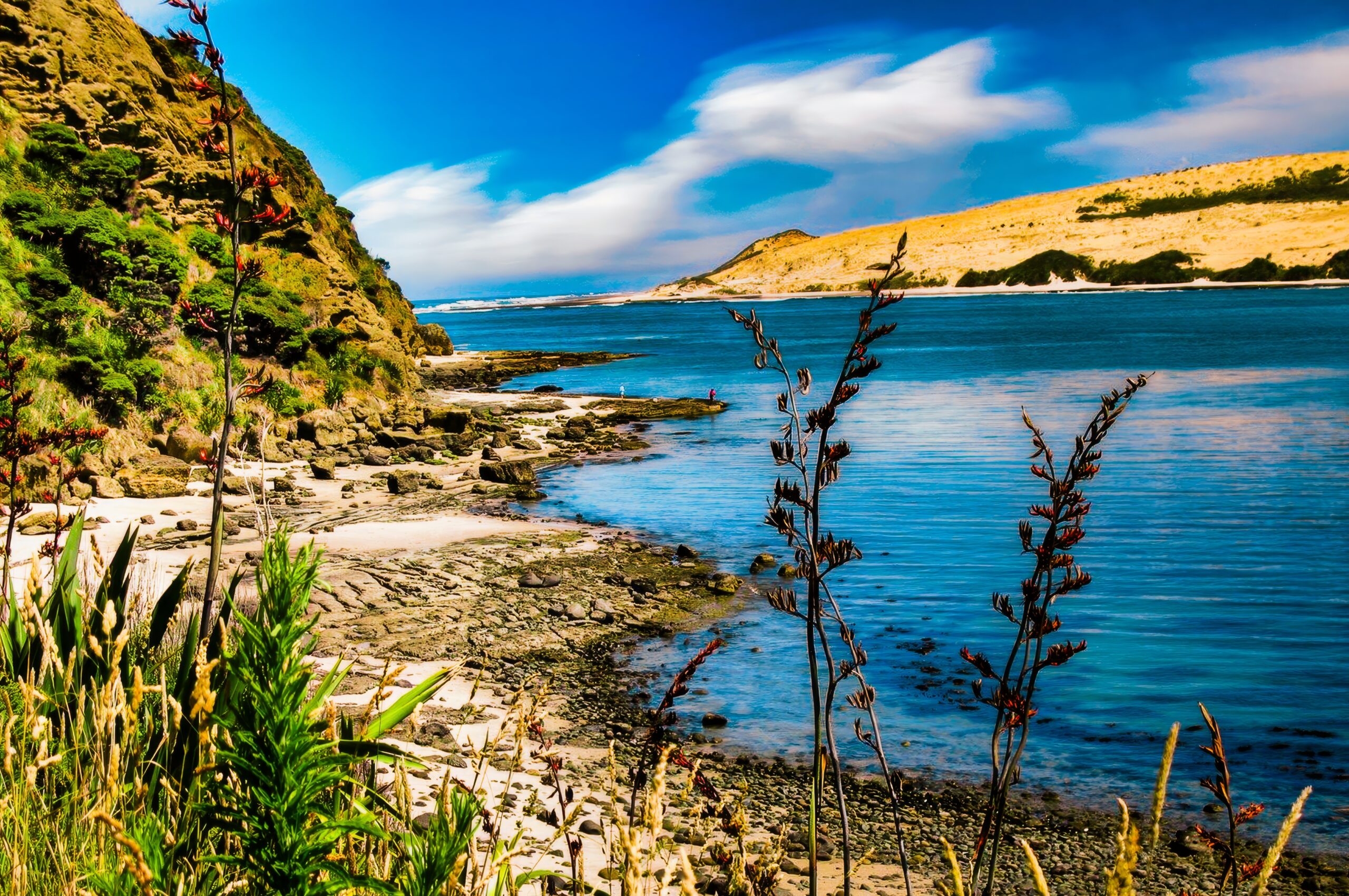
Study first. Reveal the critique second.
Before opening Ian’s observations, take time to form your own judgement.
- Where does your eye go first?
- What is working well?
- What distracts from the subject?
- Would you change the crop?
- What total score would you give?
Reveal Ian’s Example Critique
Impact: Strong colour and a layered coastal view create immediate energy and a clear sense of place.
Composition: The curved shoreline leads the eye into the harbour, while the cliff and distant dune give the frame depth. The tall flax stalks add scale, but the central stems compete with the view.
Light and colour: Bright sunlight gives excellent separation, although the intense blue and yellow-green saturation feels stronger than natural.
Improvement: Reduce saturation slightly, recover detail in the bright sand and clouds, and consider a modest crop from the bottom or right to simplify the foreground.
Decision: Keep and improve. The location, depth and visual energy are strong enough to justify a careful re-edit.
Two Hokianga Critique Examples
Compare how atmosphere, composition and editing choices affect two very different landscape photographs.

Mist over the harbour
Koutu Beach, Hokianga
- Impact: Warm light, mist and reflections create a quiet, cinematic mood.
- Composition: The diagonal beach draws the eye inward and the dark tree mass anchors the centre, though its heavy silhouette dominates the mid-frame.
- Light: The layered mist separates the hills effectively; some shadow detail in the trees and beach is lost.
- Colour and tone: The warm sky against cooler water is appealing, but the teal-orange contrast and dark greens appear strongly processed.
- Improvement: Lift the deepest shadows selectively, soften cyan in the water and reduce local contrast around the trees without flattening the mist.
Decision: Keep and refine—the atmosphere and sense of place are the photograph’s main strengths.
Harbour and coastal flax
Hokianga Harbour
- Impact: Vivid coastal colour gives the scene an immediate postcard quality.
- Composition: Shoreline curves and overlapping landforms produce good depth, while the flax frames the location and identifies the New Zealand setting.
- Background: The two small figures supply scale, but the central dark stalk and busy lower edge interrupt the clean movement toward the water.
- Technical quality: Detail is strong across the scene; bright sand, cloud and foliage approach a harsh, crunchy look.
- Improvement: Reduce global saturation and clarity, recover highlights, and test a slightly tighter crop while retaining enough flax to preserve context.
Decision: Keep and re-edit—the composition is engaging, and more restrained processing would let it breathe.
Course Resources
Downloadable tools help you use the critique system away from the screen and apply it to your own photography.
Critique Worksheet
Printable 10-category scoring sheet with observation and improvement fields.
Open Downloads →Quick Checklist
A one-page reference for camera clubs, field reviews and editing sessions.
Get the Checklist →Practice Gallery
A growing selection of photographs to critique before revealing instructor notes.
Open Gallery →Course Glossary
Clear explanations of critique, composition, lighting and editing terminology.
Open Glossary →Complete the Short Course
Demonstrate what you have learned by applying the full system to real photographs.
Practical Project
Critique five of your own photographs and recommend one clear improvement for each.
Final Quiz
Check your understanding of visual, technical and editing critique decisions.
Certificate
Record completion of the lessons, practical project and final knowledge check.
Look longer. Notice more. Improve with purpose.
Begin with the welcome lesson, then work through the course one photograph and one informed decision at a time.